
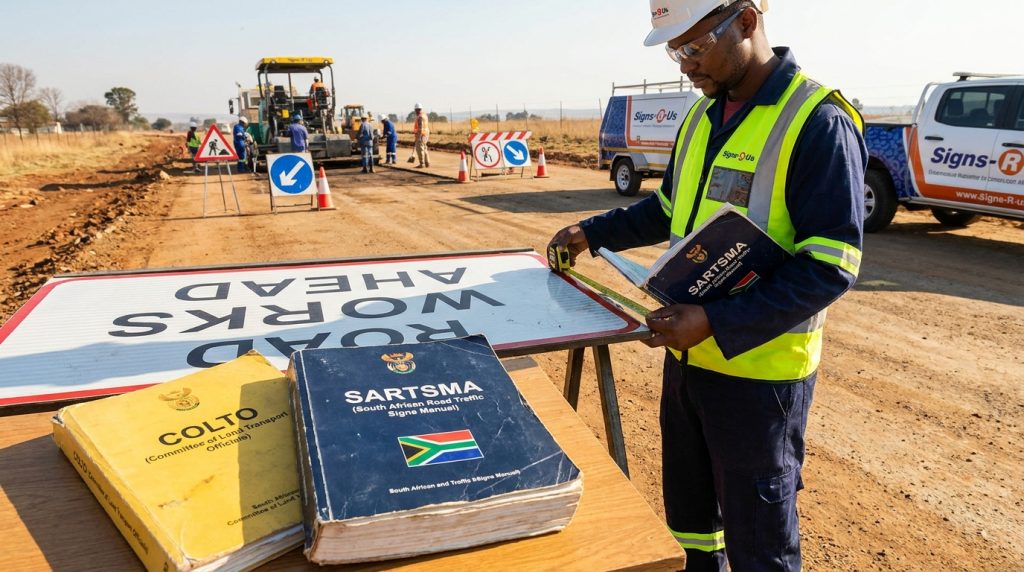
Any construction or infrastructure project that affects a public road carries a legal obligation to protect the people who use it. Temporary road signs in South Africa are not optional additions to a traffic management plan; they are a legal requirement under clearly defined national frameworks. For project managers, getting this right from the first day of groundwork is not just about avoiding fines. It is about keeping workers safe, maintaining traffic flow, and ensuring your project does not face delays because a site inspector has flagged non-compliant signage.
This guide walks through the legal foundations, what your signs must communicate, the situations that trigger that obligation, and how to source correctly manufactured signage for your site.
The Legal Framework Governing Temporary Road Signs in South Africa
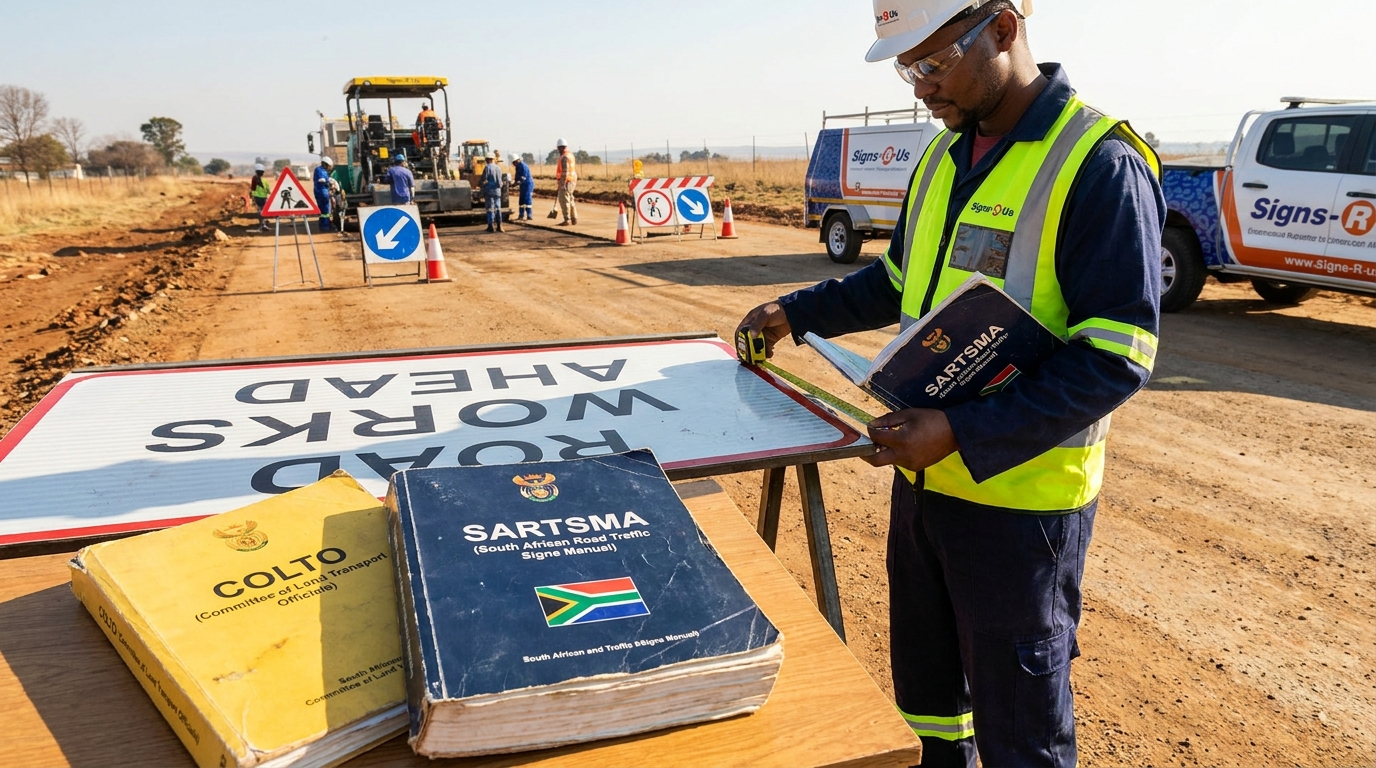
Two documents sit at the centre of temporary road signage compliance in South Africa: SARTSMA and COLTO.
SARTSMA (the South African Road Traffic Signs Manual) is the definitive national standard for all road traffic signs, including temporary ones. It specifies sign categories, dimensions, colours, retroreflectivity classes, and placement rules. Any sign installed alongside a public road must conform to SARTSMA specifications. There is no discretion here; a sign that does not meet the standard is non-compliant regardless of how practical it might seem to the person who ordered it.
COLTO (the Committee of Land Transport Officials) produced the standard specifications for road and bridge works, and its provisions extend to the traffic accommodation requirements that must be in place during those works. Together, SARTSMA and COLTO form the backbone of what any responsible site must demonstrate before, during, and after active road works.
Beyond these two frameworks, the Occupational Health and Safety Act (OHS Act) and the National Road Traffic Act impose additional duties on employers and contractors. A failure to provide adequate temporary signage can constitute a breach under multiple pieces of legislation simultaneously, which compounds the consequences significantly.
For a detailed breakdown of how SARTSMA and COLTO interact on live projects, the article on SARTSMA vs COLTO: what signage compliance means for your project covers the practical distinctions clearly.
When Are Temporary Road Signs Legally Required?
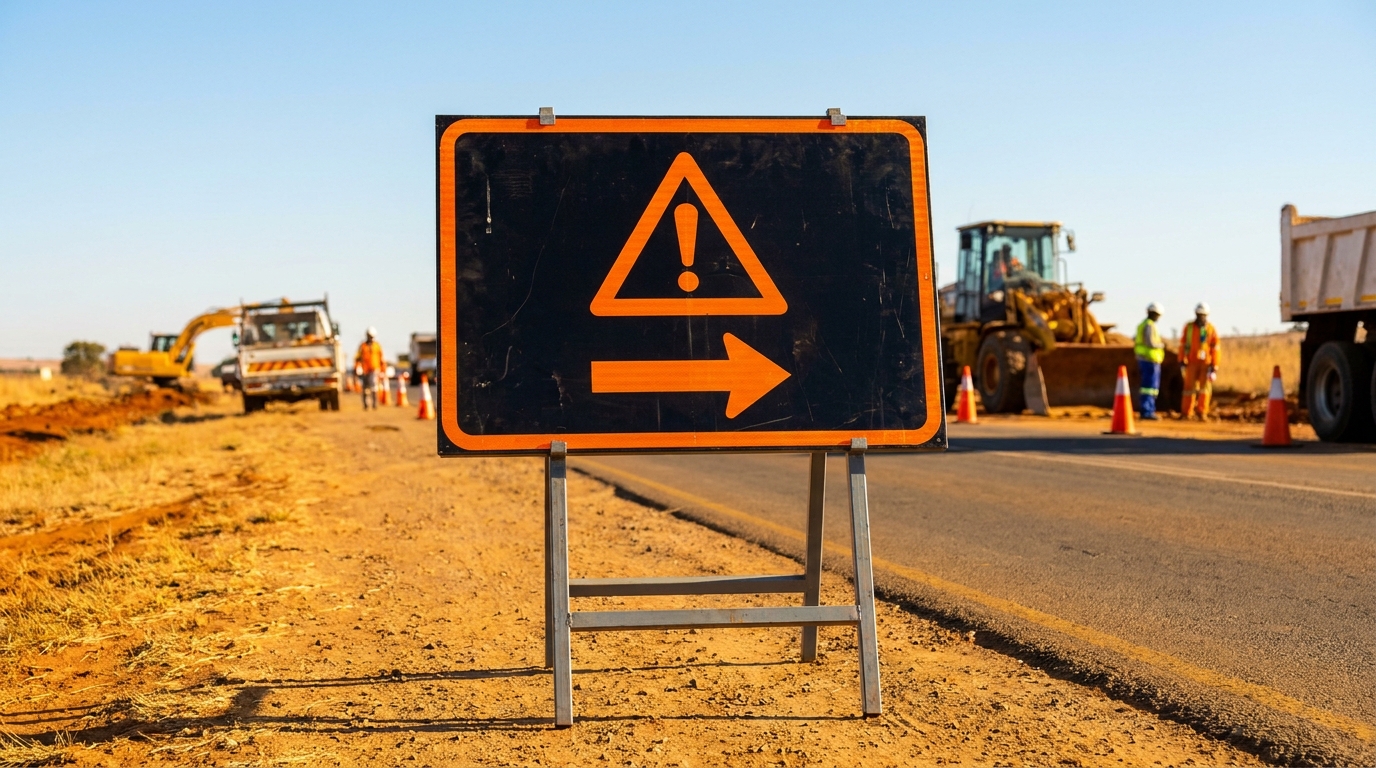
The short answer is: whenever your works affect the normal movement of vehicles or pedestrians on or adjacent to a public road. That covers more situations than many project managers initially expect.
Road Construction and Rehabilitation
This is the most obvious trigger. Any project that involves breaking, excavating, resurfacing, or otherwise modifying a road surface requires a full temporary traffic management scheme, including advance warning signs, lane closure signs, speed restriction signs, and end-of-works signs. The scheme must be designed and implemented before any plant or personnel enter the road reserve.
Utility and Infrastructure Works
Water pipe installations, fibre cable laying, stormwater upgrades, and electrical reticulation works frequently require trenching across or alongside public roads. Even if your trench runs only a metre into the verge, you are legally obligated to sign the hazard appropriately. Many contractors underestimate this requirement and assume that cones alone will suffice. They do not.
Bridge and Culvert Works
Load restrictions, single-lane operations, and detours associated with bridge maintenance or replacement must all be communicated through correctly specified temporary signs. COLTO is particularly specific about load restriction signage in these contexts, and the signs themselves must meet SARTSMA dimensional and retroreflectivity requirements.
Events and Temporary Detours
Large-scale events that require road closures or temporary detour routes also fall within the scope of temporary road sign requirements. Municipal approval processes for these events typically require a traffic management plan, and that plan must reference compliant signage before approval is granted.
Emergency Situations
A burst water main, a structural failure, or a similar emergency that creates a sudden hazard on or near a road requires immediate temporary signage. The law does not suspend its requirements because the situation is unplanned; contractors and municipalities are expected to maintain sign stocks or have rapid-supply arrangements in place for exactly this reason.
What Temporary Road Signs Must Communicate
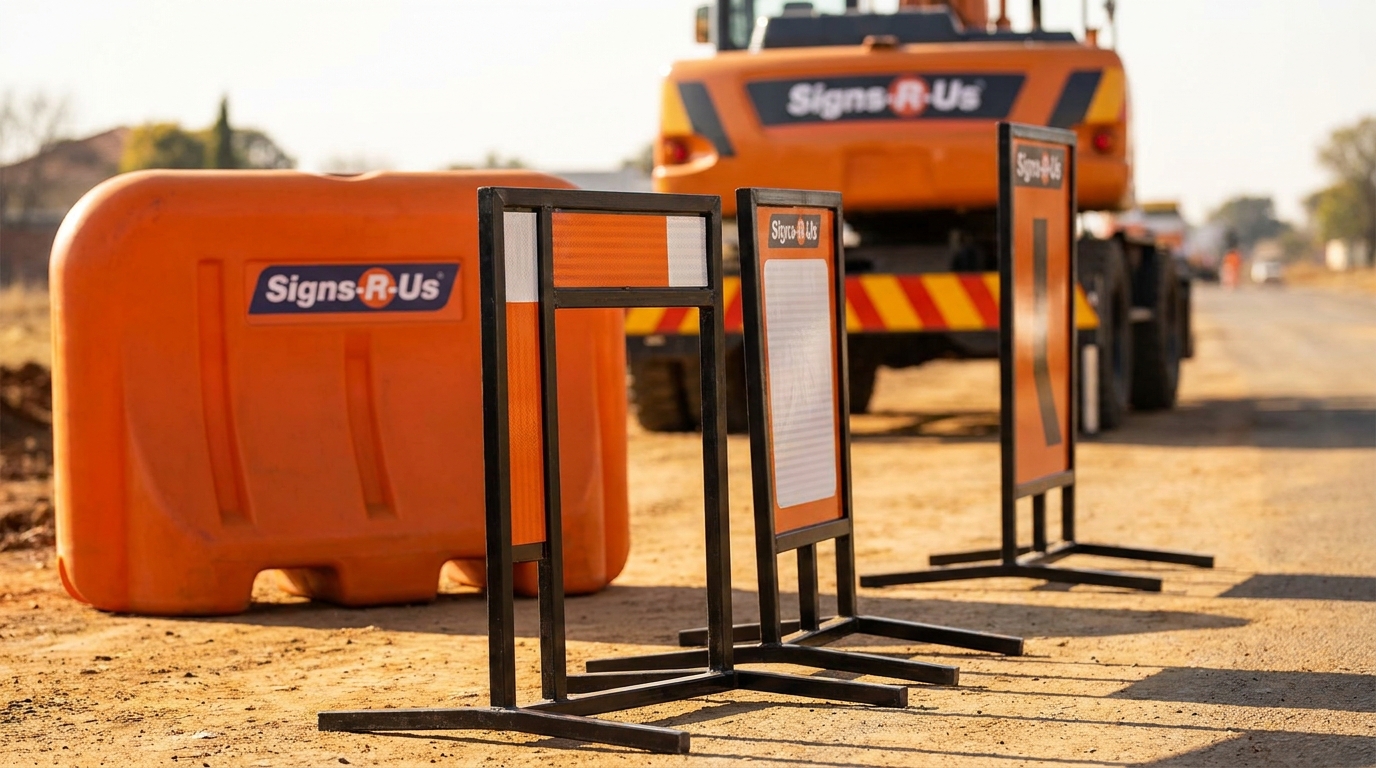
SARTSMA classifies temporary traffic signs into several functional categories, and each category carries specific communication obligations.
Advance Warning Signs
These signs are placed ahead of the works area to give road users adequate reaction distance. They must warn of the nature of the hazard (road works, loose gravel, uneven surface), indicate the distance to the hazard, and, where relevant, specify a speed reduction. The placement distances required by SARTSMA vary by the posted speed limit of the road, and using the wrong distance is as much a compliance failure as using the wrong sign type.
Speed Restriction Signs
A temporary speed restriction must be introduced progressively on high-speed roads. A driver travelling at 120 km/h on a national road cannot safely or legally be confronted with a single sign dropping the limit to 40 km/h without intermediate reductions. SARTSMA prescribes the step-down sequence, and your traffic management plan must reflect it.
Lane Control and Channelisation Signs
Where lanes are closed or traffic is redirected, signs and road markings must make the routing unambiguous. Vague channelisation is one of the most common causes of accidents in road works zones. Signs in this category include lane closure signs, keep left or keep right signs, and merge signs, all of which must carry the correct SARTSMA designation and be manufactured to the correct specification.
End-of-Works Signs
Once the works zone ends, road users must be clearly informed. End-of-restriction signs lift the temporary speed limit and signal the return to normal road conditions. Leaving a speed restriction in place after works are complete is a compliance failure in its own right, and one that attracts legitimate complaints from road users.
Information and Detour Signs
Where traffic is diverted, every turn in the detour route must be signed. A detour that loses drivers halfway around the route is a safety hazard and a legal liability. Guidance Signs and Information Signs must conform to SARTSMA’s colour and symbol specifications for temporary applications.
Material and Manufacturing Requirements
Compliance is not only about what a sign says; it is equally about how the sign is made. SARTSMA specifies retroreflectivity classes for temporary signs, which means that a sign printed on non-reflective material fails the standard even if the message and dimensions are correct.
Temporary road signs in South Africa are commonly manufactured on aluminium or Chromadek sheeting, with Class 1 or Class 2 retroreflective sheeting applied to the face. The grade required depends on the road classification and the sign’s position. For high-speed roads, higher-grade sheeting is typically mandated. The article on why South African sites choose Chromadek over plastic explains the practical and compliance advantages of metal-faced signage for demanding site conditions.
Signs must also be mounted at the correct height and on supports that comply with the relevant specifications. A correctly printed sign lashed to a tree or taped to a barrier board is not a compliant installation, regardless of how readable it might be.
Common Compliance Failures on South African Sites
Site audits across construction and infrastructure projects reveal a consistent set of recurring problems. Understanding them helps project managers avoid the same mistakes.
- Incorrect sign dimensions: SARTSMA specifies exact sizes for each sign type and road class. Undersized signs are a common finding, particularly on sites where signs have been sourced from non-specialist suppliers.
- Wrong retroreflective grade: Class 1 sheeting is sometimes used where Class 2 is required, typically because the contractor sourced the cheapest available option rather than the correct one.
- Incomplete sign sequences: Advance warning signs are in place but the corresponding end-of-works signs are missing, or speed reductions are not stepped down as required.
- Signs left in place after works are complete: This is both a compliance failure and a road safety risk. Drivers who repeatedly encounter speed restrictions that are clearly unnecessary begin to ignore all temporary signs, including the ones that matter.
- No traffic management plan: Signs cannot be placed correctly without a plan that specifies placement distances, sign types, and responsibilities. COLTO requires this documentation, and its absence undermines every other effort on the site.
How to Order Compliant Temporary Road Signs
Ordering correctly begins with knowing exactly which signs your traffic management plan specifies. A list of sign designations drawn from SARTSMA, with dimensions and retroreflectivity grades noted, is the minimum information a compliant manufacturer needs to produce the right product.
Signs-R-Us manufactures road signs and temporary traffic signs to SARTSMA specifications across a range of materials and retroreflectivity grades. Because the signs are manufactured in-house rather than sourced from a general print supplier, each sign can be produced to the exact dimension and sheeting class the plan requires, with the correct SARTSMA designation applied. This matters particularly on projects where a site inspector or the road authority will audit compliance before works proceed.
For projects with non-standard requirements, such as oversized advance warning signs on high-speed roads or bilingual signs for sites in areas where multiple languages are in common use, a road signs service that handles custom specifications is far more reliable than sourcing from a catalogue that offers only standard sizes.
Lead times matter too. A project that starts on Monday and orders signs on the Friday before is taking a risk. Retroreflective sheeting application and proper substrate preparation take time if the result is to last in outdoor conditions. Build sign procurement into your project timeline as early as the traffic management plan is drafted.
Keeping Your Site Compliant Throughout the Project
Temporary road signs degrade. Retroreflective sheeting loses effectiveness when it is damaged, covered in mud, or subjected to prolonged UV exposure. A sign that was compliant when installed may not remain so three months into a project. Regular inspection of temporary signage, with replacements ordered before signs fall below the required standard, is part of the contractor’s ongoing legal obligation.
Signage maintenance on long-duration projects is often overlooked because it is not built into the initial budget. Including a maintenance allowance for temporary signs at the project planning stage is straightforward to do and far less costly than replacing a full sign scheme under pressure after a site audit.
Get Your Temporary Signage Right From the Start
Temporary road signs in South Africa are a legal requirement with defined standards, and the consequences of non-compliance extend from site shutdowns to personal liability for the responsible contractor. The frameworks are detailed, but they are not impenetrable, and working with a manufacturer who understands SARTSMA and COLTO from the outset removes much of the risk.
If your project is approaching a procurement decision on temporary road signage, request a custom quote from Signs-R-Us with your sign schedule attached. The team will confirm specifications, advise on retroreflectivity grades for your road classification, and ensure your order is manufactured to the standard your traffic management plan requires.