
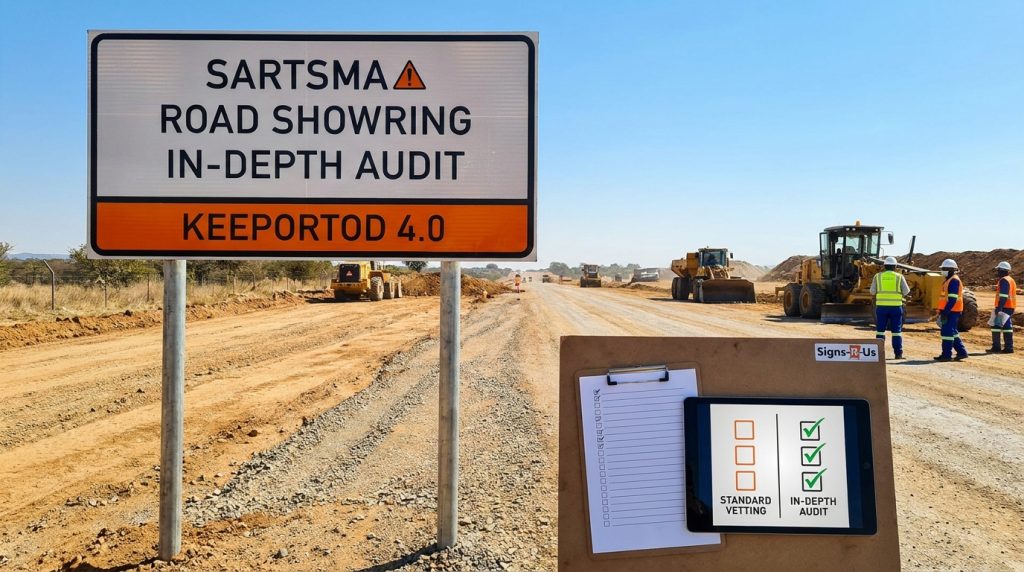
When a government or municipal tender includes signage, procurement managers face a qualification challenge that is easy to underestimate. Road signs, safety signs, and wayfinding systems are regulated products. Appointing the wrong signage supplier for a government tender in South Africa does not just risk poor-quality output; it can expose a department to compliance failures, project delays, and liability under the Occupational Health and Safety Act. The criteria that separate a qualified supplier from an unqualified one are specific, verifiable, and worth examining in detail before a contract is awarded.
Why Standard Supplier Vetting Is Not Enough
A general supplier database check will confirm tax compliance and company registration. It will not tell you whether a signage company manufactures its own products or simply resells imported stock, whether its signs meet SARTSMA specifications, or whether it has the capacity to deliver to a remote site on a government timeline. These are the questions that matter most when public funds and public safety are involved.
Signage on public roads, construction sites, and municipal infrastructure must meet defined technical standards. A supplier that cannot demonstrate compliance with those standards before the contract starts is unlikely to resolve the problem after it. The vetting process needs to go deeper than the standard procurement checklist.
SARTSMA Compliance as a Non-Negotiable Criterion
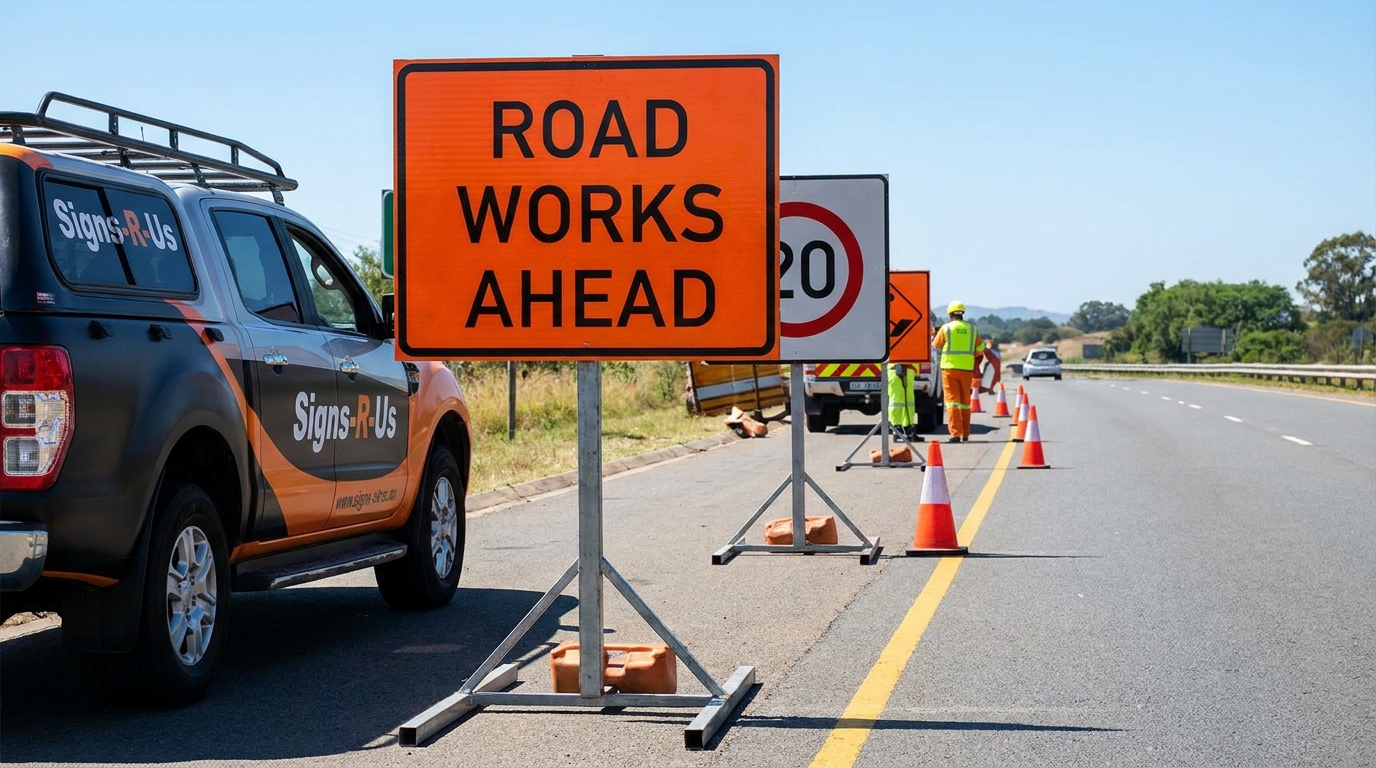
The South African Road Traffic Signs Manual (SARTSMA) governs the design, dimensions, colour, retroreflectivity, and placement of road and traffic signs in South Africa. Any supplier bidding on a government or municipal tender involving road signage must be able to demonstrate that their products conform to SARTSMA specifications.
In practice, this means asking for evidence rather than assurances. Request samples or technical data sheets that confirm retroreflectivity grades, substrate specifications, and sign face dimensions. Ask whether their production process is documented and quality-controlled against the manual’s requirements. A manufacturer that works regularly with municipalities and roads authorities will have this documentation readily available. One that does not is a risk.
For a more detailed breakdown of what SARTSMA compliance means for a specific project, the article on SARTSMA vs COLTO: what signage compliance means for your project covers the practical implications for procurement decisions.
Retroreflectivity and Material Standards
SARTSMA specifies minimum retroreflectivity levels for different sign types and locations. High-speed road environments require higher-grade sheeting than low-speed urban settings. A qualified supplier will know which grade applies to each sign type on your scope of work and will be able to confirm the sheeting brand and class in writing. Chromadek steel substrate is widely used for permanent road signs in South Africa because of its durability in harsh weather conditions. Suppliers who can explain material selection with reference to the relevant standards are demonstrating exactly the kind of technical competence a tender should be screening for.
CIDB Grading and What It Tells You

The Construction Industry Development Board (CIDB) register is one of the most useful tools available to procurement officers handling infrastructure-related tenders. CIDB grading reflects a contractor’s financial capacity, experience, and track record. For signage work that forms part of a larger infrastructure or construction project, the supplier’s CIDB grading will indicate whether they are eligible to work at the contract value being tendered.
Check the CIDB register directly rather than relying on a certificate provided by the bidder, since gradings are updated and certificates can be out of date. The relevant work class for signage contractors is typically Specialist Works (SP), and the grading level should match or exceed the value of the signage portion of the tender. A supplier whose grading falls below the threshold is not a minor risk; they are formally ineligible for that contract.
Manufacturer or Reseller: Why the Distinction Matters for a Government Tender
This is one of the most overlooked qualification questions in signage procurement, and it has significant implications for quality control, lead times, and accountability.
A reseller sources signs from a third-party manufacturer, often with little visibility into the production process. If a sign fails a retroreflectivity check or arrives with incorrect dimensions, a reseller has limited ability to correct the problem quickly. They are dependent on their supplier’s production schedule, which may not align with your project’s milestones.
A manufacturer produces signs in-house. They control material selection, print quality, substrate preparation, and finishing. When a query arises, they can investigate and resolve it without waiting for a third party. For government contracts where accountability is scrutinised and timelines are fixed, appointing a manufacturer directly reduces the number of parties in the supply chain and the number of points at which quality can degrade.
Ask bidders directly: do you manufacture the signs you are quoting on, or do you source them from another party? Then verify the answer. A genuine manufacturer will be able to describe their production equipment, show their facility, and provide a quality management process. Signs-R-Us manufactures signage directly, which means every product that leaves the facility is traceable to a documented production process, not reliant on a third party’s quality standards.
Checking References from Comparable Contracts
References are standard practice in procurement, but the quality of the reference matters as much as its existence. A signage supplier who has delivered a small commercial project is not the same as one who has supplied road signs across a provincial road network or installed safety signage across an active mining operation.
When evaluating references for a government or municipal tender, ask for examples of contracts that are comparable in:
- Contract value and volume of signs
- Sign type (road signs, OHS signage, wayfinding, or a combination)
- Site environment (urban roads, construction sites, remote infrastructure)
- Delivery timeframe and whether it was met
Follow up with the reference contacts directly. Ask specifically about delivery reliability, responsiveness to queries, and whether the supplied signs passed inspection or required remediation. A supplier with a strong government track record will have references who can answer those questions without hesitation.
BEE Compliance and Preferential Procurement
Broad-Based Black Economic Empowerment (BEE) status is a formal evaluation criterion in South African government procurement under the Preferential Procurement Policy Framework Act (PPPFA). Suppliers bidding on government tenders are required to hold a valid BEE certificate issued by an accredited verification agency.
When assessing BEE compliance, confirm that the certificate is current (certificates must be renewed annually), that it was issued by a SANAS-accredited verification agency, and that the contributor level aligns with the points your tender awards at that level. A Level 1 or Level 2 contributor will score maximum points under the preferential procurement formula; a supplier without a valid certificate scores nothing under that criterion and may be disqualified depending on the tender conditions.
It is worth noting that BEE compliance is not just a scoring mechanism. It signals that a supplier is operating formally, is subject to independent auditing, and has structured its business to meet regulatory requirements. These are characteristics that tend to correlate with broader operational reliability.
OHS Signage Obligations and Supplier Knowledge
Many government tenders include OHS signage requirements alongside road or directional signs. The Occupational Health and Safety Act places specific obligations on employers and contractors, and signs that do not meet the prescribed standards for colour, symbols, and wording are not compliant, regardless of how well they are manufactured.
A qualified supplier should be able to distinguish between mandatory signs, prohibition signs, warning signs, and emergency signs, and should understand the South African National Standards (SANS) specifications that apply to each category. If a bidder cannot explain the difference between an ISO-compliant warning sign and a general-purpose notice board, they are not equipped to deliver OHS signage on a government contract.
The plain-English guide to OHS Act signage obligations is a useful reference for procurement teams who need to understand what their own obligations are before specifying signage in a tender document.
Installation Capacity and Post-Supply Support
A sign that is manufactured correctly but installed poorly is still a failure. Government contracts often require the supplier to manage installation, which means the supplier needs field teams, appropriate vehicles, and experience working on live roads or active sites under traffic management conditions.
Ask bidders whether installation is handled in-house or subcontracted. If it is subcontracted, who is the subcontractor and what is their CIDB grading? Confirm that the installation team holds the relevant competencies for the site environment, including working at height if gantry-mounted signs are involved, and road traffic management certification if signs are being installed on public roads.
Post-supply support is equally relevant. Government infrastructure is long-term infrastructure. Signage maintenance, replacement of damaged signs, and periodic retroreflectivity checks are ongoing requirements. A supplier who can provide maintenance services through a structured agreement reduces the administrative burden of managing multiple vendors over the life of a project.
A Qualification Checklist for Procurement Managers
Before shortlisting a signage supplier for a government or municipal tender, work through these verification points:
- SARTSMA compliance: Can the supplier provide technical documentation confirming that road signs meet current SARTSMA specifications for sheeting grade, colour, and dimensions?
- CIDB registration: Is the supplier registered on the CIDB database at the appropriate grading for the contract value?
- Manufacturing vs reselling: Does the supplier manufacture its own products, and can it demonstrate this with facility details and a quality management process?
- Comparable references: Has the supplier delivered government or municipal contracts of similar scale and sign type, and are references available and verifiable?
- Valid BEE certificate: Is the certificate current, issued by a SANAS-accredited agency, and at the contributor level claimed in the bid?
- OHS signage competency: Does the supplier understand SANS-compliant OHS sign categories and can it supply signs that meet statutory requirements?
- Installation capacity: Does the supplier have in-house installation teams with the relevant site and road-working competencies?
- Maintenance capability: Can the supplier support the signage over the infrastructure’s operational life?
Signs-R-Us holds the relevant compliance credentials, manufactures signage directly from its South African facility, and has supplied and installed signage for road, mining, construction, and municipal projects across the country. The certificates and credentials are available for inspection through the certificates page, and the full range of services relevant to government procurement is outlined on the services overview.
Getting the Tender Specification Right From the Start
A well-qualified supplier can only deliver a compliant outcome if the tender specification is clear. Vague signage scopes lead to non-comparable bids, disputes over what was included, and signs that technically meet the specification as written but fail the purpose they were installed for.
If you are drafting a tender specification and need guidance on what to include for road signs, OHS signs, wayfinding systems, or construction site signage, the Signs-R-Us team can provide input before the tender is issued. Early engagement with a manufacturer who understands the regulatory environment is a practical way to produce a specification that attracts qualified bids and reduces post-award risk.
To discuss a current or upcoming tender, or to request documentation for supplier qualification purposes, contact the Signs-R-Us team through the contact page or submit a detailed project brief through the custom quote request.