

The Occupational Health and Safety Act 85 of 1993 (the OHS Act) requires South African employers to take every reasonably practicable step to provide and maintain a working environment that is safe and without risk to the health of employees. Signage sits at the centre of that obligation. Whether you manage a warehouse in Johannesburg, a construction site in Durban or a manufacturing facility in the Western Cape, the OHS Act signage requirements for South Africa apply to you, and getting them wrong carries real consequences. This guide sets out what you need to display, the categories that matter, the material standards that apply, and what a non-compliant site risks when the Department of Labour comes knocking.
What the OHS Act Actually Requires on Signage

The OHS Act does not publish a single itemised list of signs and say “display these.” Instead, it places a general duty on employers through Section 8, supported by sector-specific regulations, to identify hazards, assess risk and then implement controls. Signage is one of those controls. The Regulations for Hazardous Chemical Substances, the Construction Regulations, the General Safety Regulations and the Driven Machinery Regulations all reference the need for appropriate warning, prohibition and instruction signs at specific locations and in specific formats.
The practical standard that ties all of this together is SANS 11684, which aligns South African safety symbols with international ISO conventions. Signs must carry SABS-approved symbolics, be clearly visible, be positioned correctly and be manufactured from materials suited to the environment in which they are installed. That last point is where many employers fall short.
The Four Main Categories of OHS Act Signage Requirements in South Africa
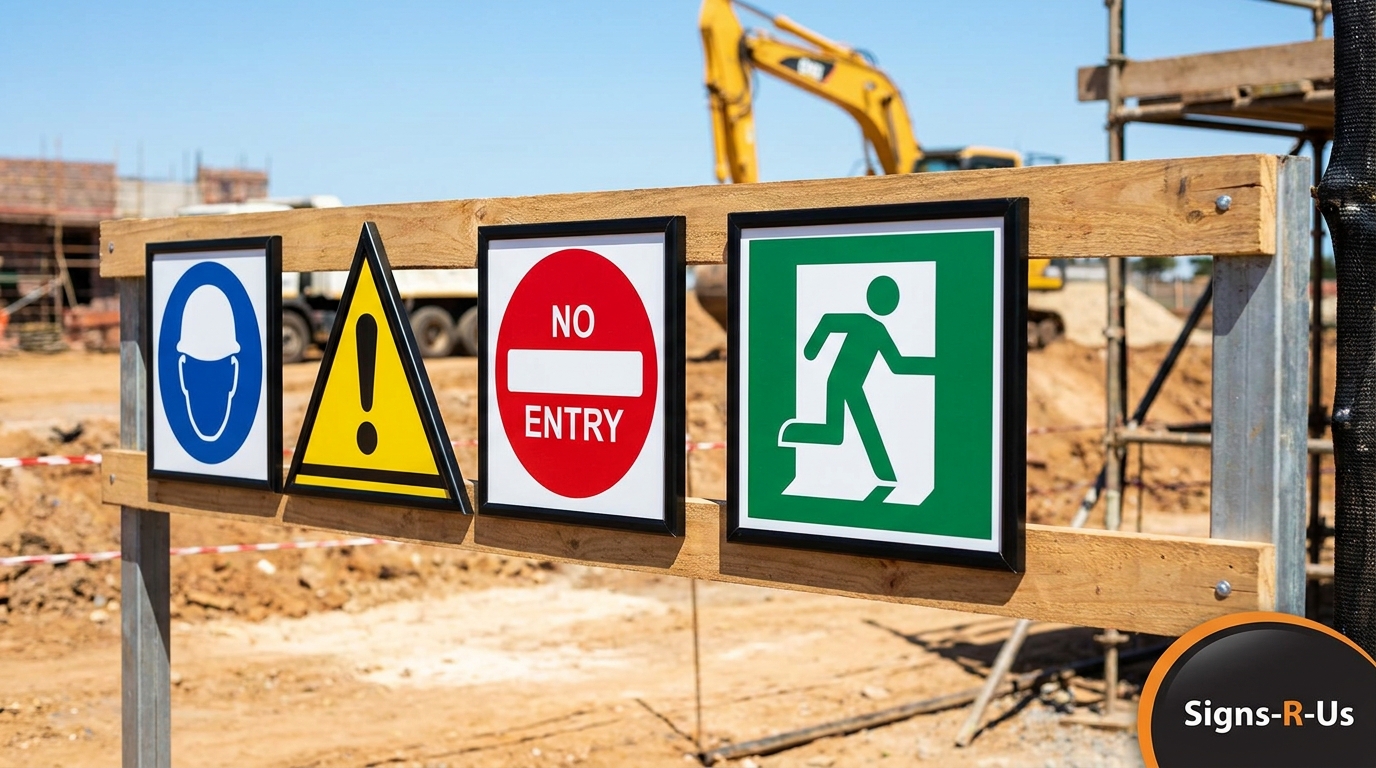
Safety signs are not interchangeable. Each category has a defined shape, colour combination and meaning. Using the wrong type to communicate a particular hazard does not just look unprofessional; it creates a compliance gap and, more importantly, it confuses workers who have been trained to read signs by their visual format alone.
Prohibition Signs
Prohibition signs tell people what they must not do. They use a red circular border with a red diagonal crossbar over a black symbol on a white background. The format is immediately recognisable and internationally standardised.
A common South African workplace example is the “No Smoking” sign, required by the National Environmental Management: Air Quality Act and practically universal in warehouses, fuel handling areas and chemical stores. Other prohibition signs you will routinely see include “No Unauthorised Entry,” “Do Not Operate This Machine” and “No Open Flames.” Anywhere a specific behaviour creates a hazard, a prohibition sign is the correct control to display.
Warning Signs
Warning signs alert workers and visitors to a hazard that cannot be eliminated. They use a yellow (or amber) equilateral triangle with a black border and a black symbol inside. The yellow triangle is one of the most widely recognised safety cues across all industries.
On a South African construction site, a “Falling Objects” warning sign is typically mandatory wherever overhead work is in progress. In a warehouse, “Forklift Operating Area” and “Uneven Surface” warning signs protect pedestrian workers who may not have line of sight to the hazard. Mining operations make particularly heavy use of warning signs to flag electrical hazards, unstable ground and restricted zones.
Mandatory Instruction Signs
Mandatory instruction signs tell workers what they must do. They use a blue circular background with a white symbol. These are the signs that specify personal protective equipment (PPE) requirements and other compulsory actions.
“Safety Helmets Must Be Worn,” “Eye Protection Required” and “High-Visibility Vest Compulsory” are all standard examples across South African worksites. In practice, these signs should appear at the entry point to any zone where the instruction applies, so workers receive the instruction before they enter the hazardous area rather than after. Posting a mandatory PPE sign ten metres inside the area it governs is a compliance error that inspectors notice.
Emergency and First-Aid Signs
Emergency signs use a green background with a white symbol. They cover first-aid locations, emergency exits, assembly points and emergency equipment such as eyewash stations and emergency showers. Green is internationally reserved for safety information and emergency routes, which is why it must never be used for any other category of sign.
In a South African warehouse or factory, the most frequently cited gap is the absence of clearly marked first-aid station signs. The General Safety Regulations require that a first-aid box be provided and that its location be clearly indicated. A green first-aid cross sign is the correct way to meet that obligation. Emergency exit routes must similarly be marked with green directional signs at every decision point along the route.
Materials and Visibility Standards
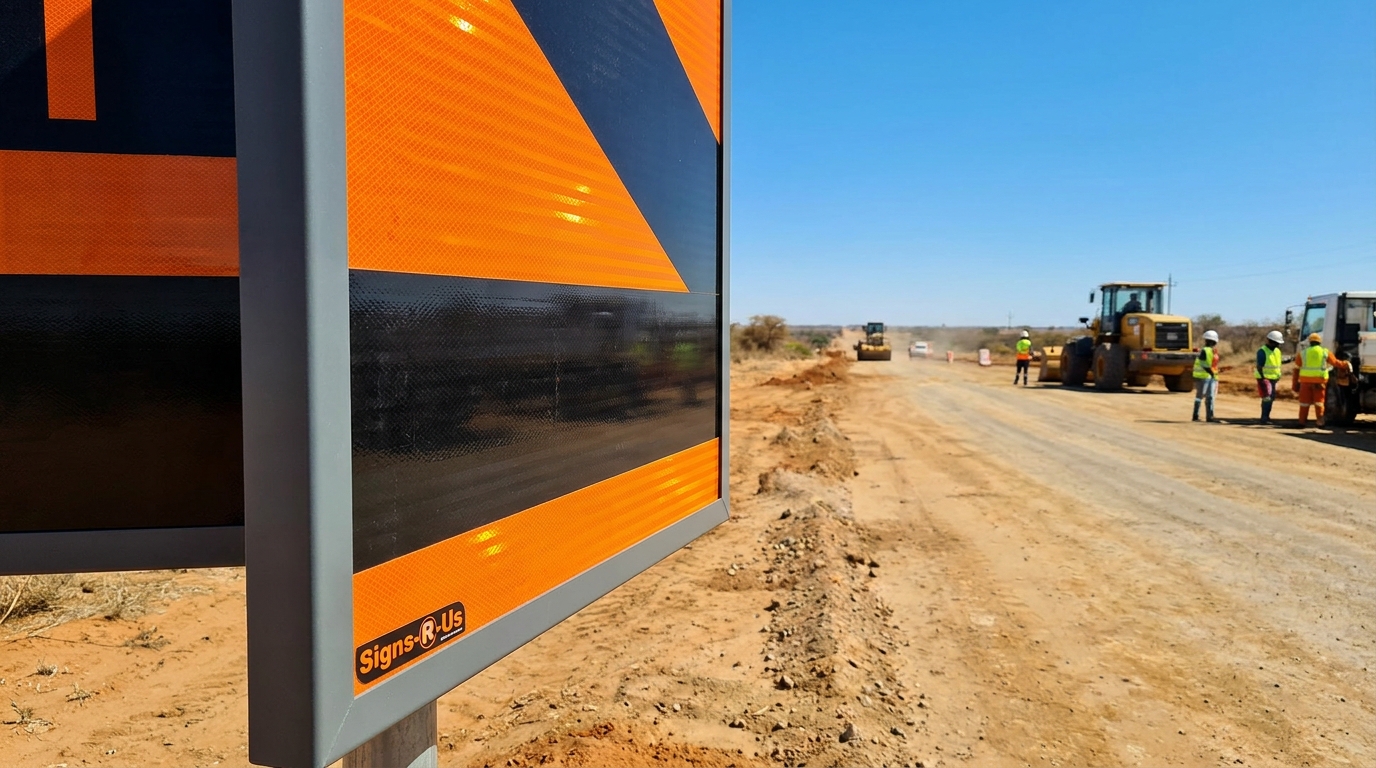
Selecting the right sign category is only part of the requirement. The material from which a sign is manufactured determines whether it meets the conditions of the environment in which it is installed.
SABS-Approved Symbolics
Signs must carry symbols that conform to SANS 11684. This means the symbol itself, its proportions, its colours and its meaning have all been standardised. A bespoke or informal sign that roughly approximates a safety symbol does not satisfy the requirement. If you are sourcing safety signs, confirm that the supplier produces SABS-approved symbolics. This is a non-negotiable baseline.
ABS and Chromadek for General Use
For most indoor and outdoor applications, signs manufactured from rigid ABS plastic or Chromadek (a pre-painted galvanised steel sheet) offer durability, UV resistance and a clean finish that remains legible over time. Chromadek is particularly well suited to outdoor and industrial environments where signs are exposed to weather, dust and physical contact. ABS is a practical choice for indoor facilities and general workplace applications. Both substrates are available with SABS-approved symbolics applied by screen printing or digital print under a protective laminate.
Photoluminescent Signs for Low-Light Environments
Certain environments require signs that remain visible when artificial lighting fails or is absent entirely. Photoluminescent (glow-in-the-dark) signs absorb ambient light and re-emit it in darkness, making them the correct material choice for emergency exit routes, stairwells, plant rooms and any area where power failure is a realistic scenario.
The Construction Regulations and the requirements that govern mines and tunnels are particularly specific about photoluminescent signage on evacuation routes. If your facility has areas where workers could be stranded in darkness during an emergency, photoluminescent signs are not optional. They are part of your emergency preparedness obligation under the OHS Act.
What Happens During a Department of Labour Inspection
The Department of Labour (DoL) conducts routine and complaint-triggered inspections of workplaces across South Africa. A labour inspector has the authority to enter any workplace, examine records, interview employees and issue instructions or prohibition notices. Signage is one of the first physical checks an inspector carries out, precisely because it is visible and easy to assess.
Non-compliance can result in a written notice to remedy the contravention within a specified period, a prohibition notice that stops work in the affected area until the issue is resolved, and, in serious cases, prosecution under the OHS Act with fines or, for repeat offenders, imprisonment. Beyond the legal consequences, a signage failure documented in an inspection report creates a paper trail that can be used against an employer in the event of a workplace injury claim.
The practical takeaway is straightforward: signage compliance is far cheaper and simpler to achieve before an inspection than after an incident. An OHS signage and PPE audit of your site, matched against the sign categories covered above, will surface most gaps quickly.
Conducting a Signage Audit on Your Site
A methodical audit does not need to be complicated. Work through your site area by area, using the four sign categories as your framework.
- Map your hazards first. Identify every area where a prohibition, warning, mandatory or emergency sign is required. This includes entry and exit points, plant and machinery zones, chemical storage areas, PPE requirement zones and all emergency routes.
- Check existing signs for compliance. Are the symbols SABS-approved? Is the sign in the correct format for its category? Is it visible, undamaged and correctly positioned?
- Check materials against the environment. Indoor signs in a dry environment are a different specification from signs in a chemical processing area or on an outdoor construction hoarding. Are your photoluminescent signs installed on all emergency routes?
- Record gaps and prioritise by risk. Missing emergency exit signs and absent PPE requirement signs at zone entries are high priority. Faded or damaged signs should be scheduled for immediate replacement.
If your operations span multiple sites or you are managing a large-scale construction project, a signage specification checklist is an efficient way to standardise procurement and installation across the project. It also provides documented evidence of due diligence if an inspection or incident occurs.
For project environments in particular, the guidance in construction site signage requirements provides a useful complement to the OHS Act obligations covered here.
Combining OHS Signage with Broader Site Safety
OHS signage does not operate in isolation. On active construction and industrial sites, it works alongside physical traffic management measures, PPE provision and site induction programmes. Road cones, barrier systems and signage work as a coordinated system. A yellow warning sign identifying a forklift zone is far more effective when it is supported by physical separation between pedestrian and vehicle routes.
Mining operations carry additional complexity, with mining wayfinding signage playing a critical role in directing workers through underground or surface operations where a wrong turn can be fatal. If you manage a mining or resources site, the requirements that apply under the Mine Health and Safety Act sit alongside the OHS Act and demand a dedicated signage strategy.
Sourcing Compliant OHS Signage
Signs-R-Us supplies SABS-approved OHS safety symbolics in ABS, Chromadek and photoluminescent substrates, manufactured to meet the requirements of the OHS Act and its associated regulations. Whether you need a standard set of signs for a single facility or a fully specified signage package for a large construction or mining project, the Signs-R-Us team works through your requirements and produces signs that comply with the correct format, symbol standard and material specification for your environment.
Compliance is not a once-off purchase. Signs degrade, sites change and new hazards emerge. Signs-R-Us also provides signage maintenance services to keep your installed signs in the condition the OHS Act demands.
Take Action Before the Inspector Does
The OHS Act signage requirements for South Africa are not ambiguous on the core obligation: employers must display the correct signs, in the correct format, manufactured to the correct standard, in every area where a hazard exists. Meeting that obligation protects your workers, protects your business from DoL penalties and creates the documented compliance record that matters when things go wrong.
Ready to close the gaps on your site? Request a custom quote from Signs-R-Us and specify exactly what your site requires, including sign category, substrate, quantity and installation environment. The Signs-R-Us team will confirm the correct SABS-approved specification for each sign and provide a clear, itemised supply proposal. You can also browse the full range of OHS signage and PPE products to see the substrates and formats available before you make contact.