
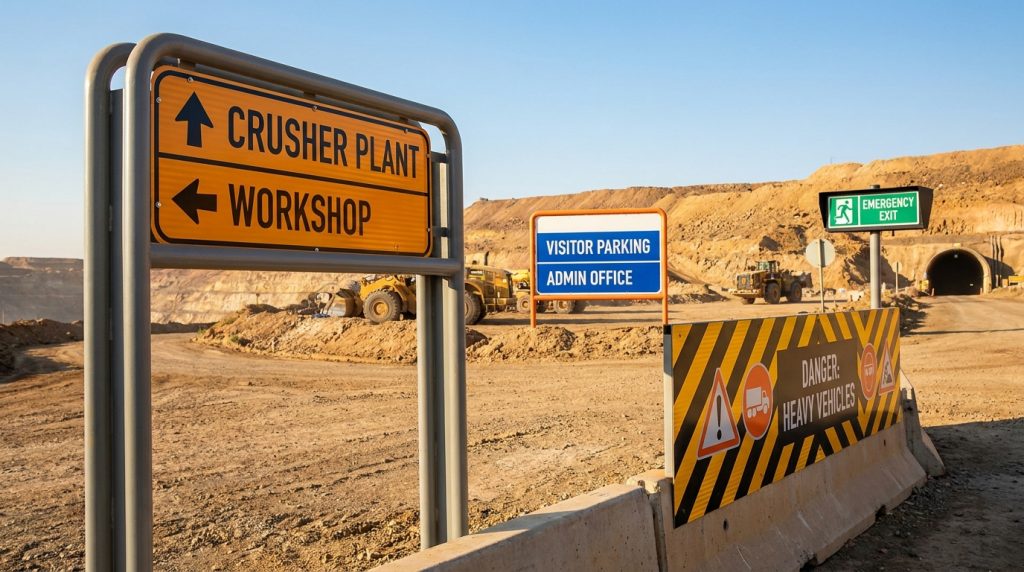
Every mine operating in South Africa carries a clear legal obligation: personnel must be able to navigate the site without guesswork. The Mine Health and Safety Act (Act 29 of 1996) and the regulations administered by the Department of Mineral Resources (DMR) require that emergency exits, muster points, and hazardous zones are identified unambiguously at all times. For procurement and health-and-safety managers, this is not an aspiration – it is a compliance baseline. Getting mining wayfinding signage in South Africa right is both a legal requirement and a practical duty of care to every person on site.
The challenge is that mines are complex, multi-zone environments. Underground workings, surface processing areas, haul roads, explosive storage, and administrative precincts each carry different risks and different regulatory obligations. A single sign order placed without a structured approach to site coverage will almost certainly leave gaps. This guide works through each category of wayfinding signage, the standards and materials that apply, and the siting logic that underpins a compliant installation.
The Four Categories of Mining Wayfinding Signage South Africa Requires
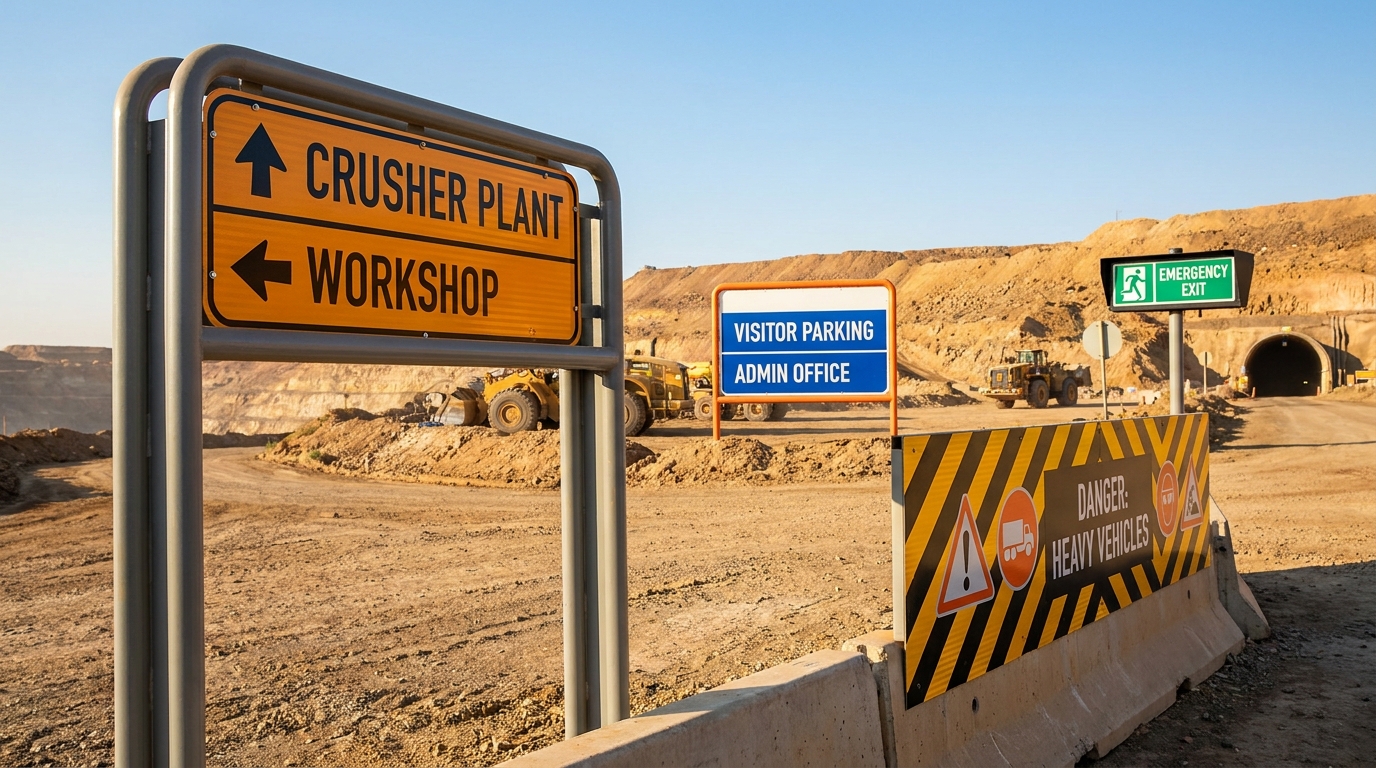
Mine wayfinding signage is not a single product type. It falls into four distinct functional categories, each governed by its own standards and each serving a specific operational purpose. Understanding the distinctions is the starting point for any compliant signage plan.
1. Directional Signage
Directional signs guide personnel and vehicles through the site under normal operating conditions. On surface, this means correctly spaced signs along haul roads, at intersections, and at facility entrances – lamp room, explosives magazine, workshop, first aid station, and so on. Underground, directional signs mark travel ways, shaft access points, and refuge bays.
The South African National Standard SANS 1186 (Safety Signs) and the broader requirements of the Occupational Health and Safety Act (OHS Act, Act 85 of 1993) inform the design and placement of these signs. For surface installations, Chromadek (a pre-painted galvanised steel sheet) is the material of choice: it is weather-resistant, rigid, and holds printed graphics well over the long service life expected in harsh outdoor environments. Where visibility in low light is a factor, retro-reflective sheeting – typically meeting SANS 1519 performance grades – is applied to the sign face so that headlights or portable lighting sources return a clear image to the viewer.
Underground directional signs present a different material requirement. In the event of a power failure, battery-backed lighting cannot be guaranteed everywhere. Photoluminescent (glow-in-the-dark) materials, charged by ambient light during normal operations, must be used where electrical lighting may fail. The DMR’s guidelines specify minimum luminance values and charge times for photoluminescent safety signs used in underground mining environments.
2. Emergency and Evacuation Signage
This category is the most safety-critical. Emergency and evacuation signs identify escape routes, emergency exits, muster points, firefighting equipment, first aid facilities, and refuge bays. They must be legible under the worst possible conditions: smoke, dust, failing light, and high stress.
SANS 1186-1 specifies the symbols, colours, and minimum sizes for emergency escape and first-aid signs. The standard is non-negotiable for any mine operating under the Mine Health and Safety Act. Green on white (or white on green) is the prescribed colour combination for emergency escape and first-aid identification. No alternative colour coding is acceptable for these functions.
Underground applications demand photoluminescent substrate as standard, not an optional upgrade. Signs must be positioned at every decision point along an escape route – each junction, each change in direction, each transition between levels – so that a person evacuating in near-darkness can follow the route by the light emitted from the signs themselves. Surface muster points and emergency assembly areas require high-mounted, retro-reflective signs visible from a distance, with clear pictograms that need no translation to be understood across a multilingual workforce.
Muster point signs in particular should be accompanied by a site map at the assembly area, showing the person’s current position relative to the site layout and the alternative muster points available. This is a detail frequently overlooked in initial signage orders and one that site audits consistently identify as a gap.
3. Hazard Identification Signage
Hazard identification signs communicate the nature and level of risk in a specific zone. They fall into two sub-groups under SANS 1186: warning signs (triangular, yellow background, black symbol) and prohibition signs (circular, red border and diagonal bar, white background). A third sub-group, mandatory action signs (circular, blue background, white symbol), is often grouped here in mining contexts because they are typically installed at the point of hazard entry.
In a mining environment, hazard signage covers a wide spectrum. Explosive storage areas, high-voltage electrical installations, confined spaces, areas requiring respiratory protective equipment, zones with overhead crane operation, and areas with restricted pedestrian access all require specific, correctly specified signage. The Hazardous Chemical Substances Regulations under the OHS Act also require GHS-compliant labelling and hazard communication at storage and processing points for chemicals.
Material selection for hazard signs on surface follows the same Chromadek and retro-reflective sheeting logic as directional signs. Underground hazard signs must again meet photoluminescent requirements where electrical lighting cannot be guaranteed. For high-traffic, high-impact zones – underground haulageways, for example – aluminium composite or heavier-gauge aluminium sheeting is often specified for impact resistance and longevity.
Placement follows a simple rule: the sign must be visible before the person reaches the hazard, with enough distance to allow a response. This means signs are positioned at the approach to a zone, not at its boundary. For vehicle traffic, the approach distance is calculated from the stopping distance of the largest vehicle using that route.
4. Access Control Signage
Access control signs define authorisation boundaries. They identify restricted areas, indicate the level of authorisation required for entry, and support the physical access control measures (gates, barriers, interlocks) that a mine’s security and safety plan requires.
These signs intersect with the Mine Health and Safety Act’s requirement that only competent and authorised persons enter certain areas. Explosive storage magazines, high-voltage substations, process plant control rooms, and shaft headgear structures are all examples of areas where access must be visually demarcated in addition to being physically controlled. Signs here typically carry both a prohibition symbol and a text instruction, in English and at minimum one other language relevant to the site’s workforce profile.
For outdoor surface installations, Chromadek with UV-stable ink or vinyl overlaminates is appropriate. Where the access control point is a formal gatehouse or checkpoint, larger-format signs on steel post systems provide the visibility and authority the location demands. Retro-reflective sheeting is again relevant wherever the access point is approached by vehicle at night.
Access control signage also includes visitor and contractor management signs: directional signs to the visitors’ entrance, contractor induction signage, and parking demarcation. These are often overlooked in the primary safety signage budget but form part of a complete site wayfinding system.
Siting, Spacing, and Maintenance Obligations
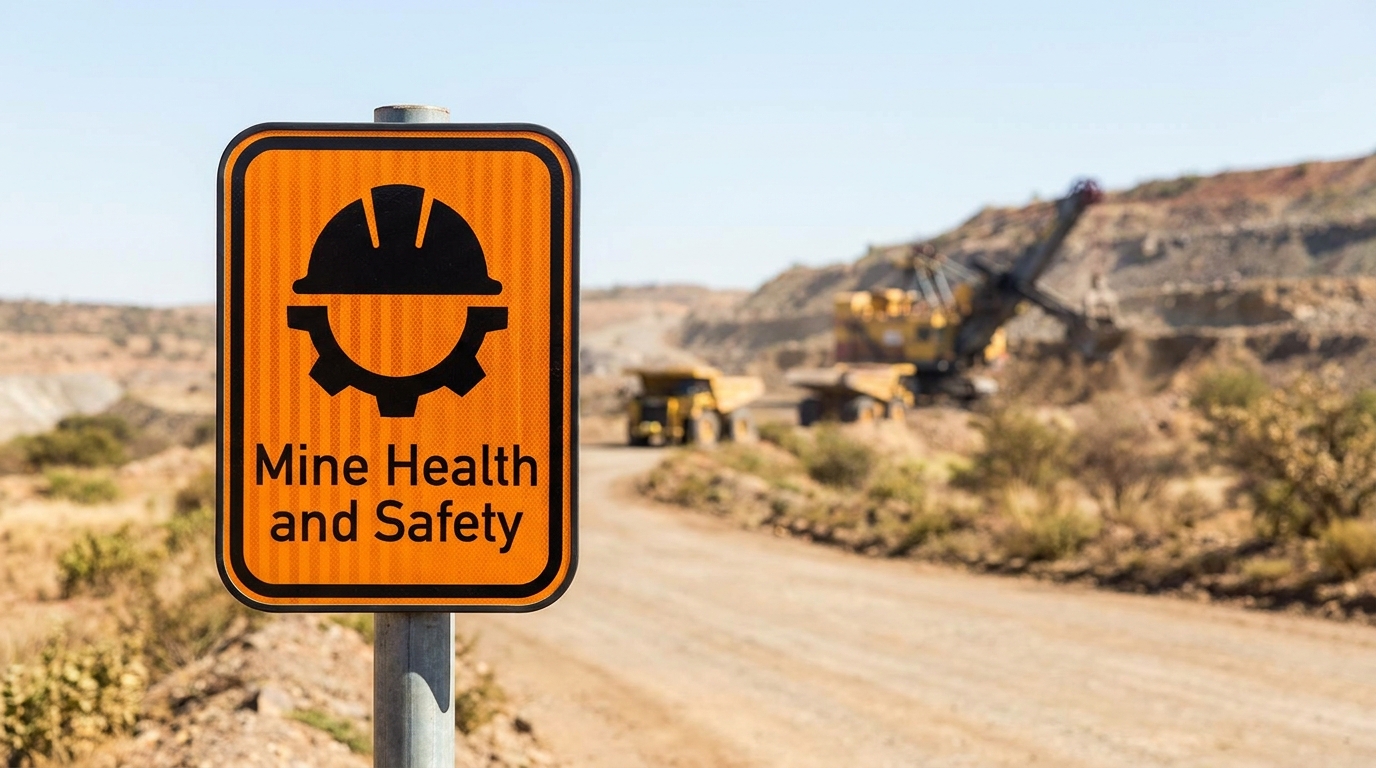
Correct sign categories and materials are necessary but not sufficient. The Mine Health and Safety Act requires that signs are maintained in a legible and effective condition at all times. This has practical implications for procurement.
Underground photoluminescent signs have a finite service life and must be replaced when luminance output falls below the specified threshold. Retro-reflective sheeting on surface signs degrades over time with UV exposure and physical abrasion from dust and debris. A maintenance schedule, tied to a periodic site inspection, is part of the compliance obligation – not an optional extra.
Spacing of directional and emergency signs underground is typically specified in the mine’s risk assessment, but a common working standard is that no person on an escape route should ever be in a position where the next sign is not visible from the last. On surface, spacing on haul roads follows road traffic sign placement logic, with approach distances calculated for the operating speed of site vehicles.
For mines undergoing expansion, rehabilitation, or changes to the ventilation plan underground, signage must be updated to reflect the current state of the workings. Outdated signs on an escape route are a direct safety risk and a clear compliance failure. Signage maintenance as an ongoing service addresses this systematically rather than reactively.
Why a Signage Audit Should Come Before the Order
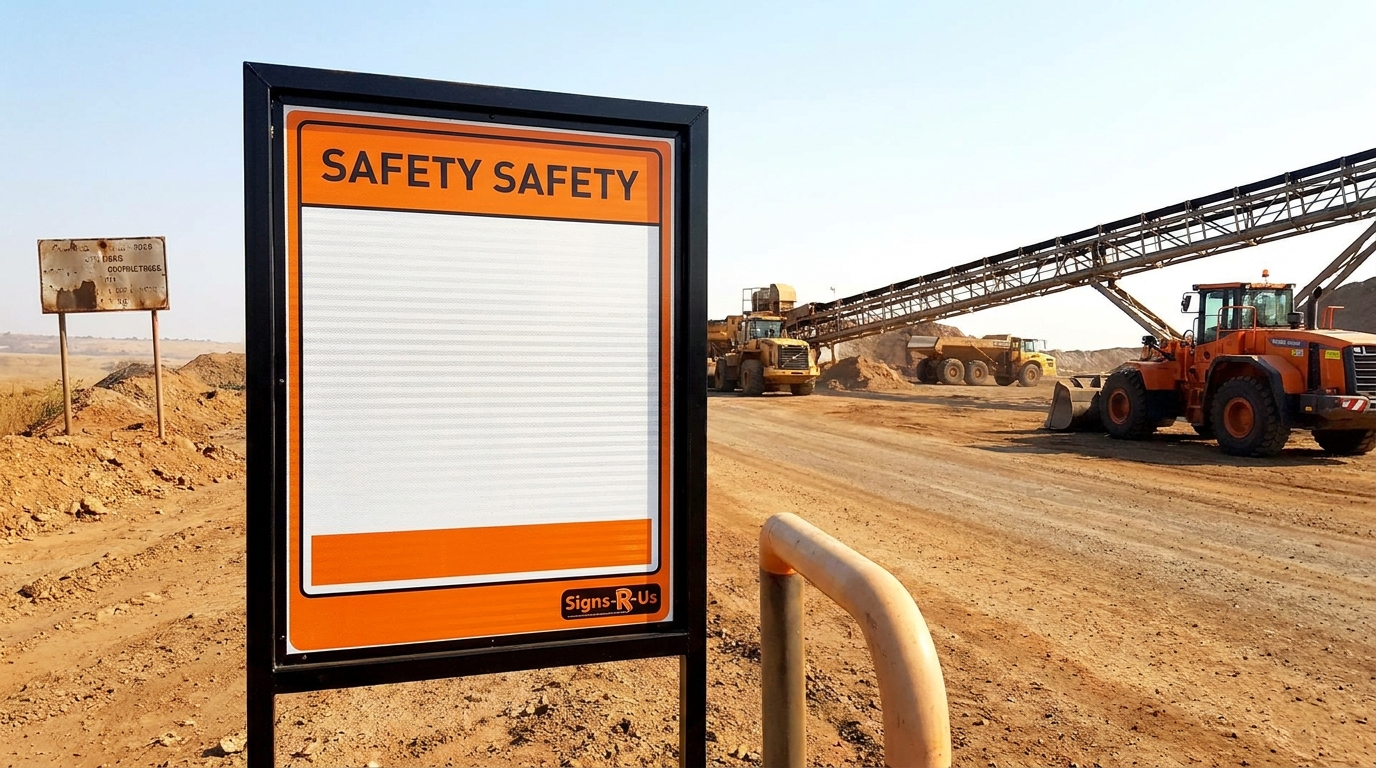
A common procurement error is to order replacement signs for what is currently on site, without first assessing whether the current installation is complete or correctly specified. Mines evolve: new working areas open, old ones close, traffic routes change, and new chemicals enter the process plant. The signage plan that was adequate three years ago may have significant gaps today.
A structured signage audit maps every zone on the site against the applicable regulatory requirements and identifies the signs that are missing, incorrectly specified, damaged, or poorly positioned. The output is a complete sign schedule: type, standard, material, size, quantity, and location for every sign the site needs. That schedule then becomes the procurement document.
Signs-R-Us provides this audit and sign schedule as part of its end-to-end service for mining clients. The mining wayfinding signage service covers the full scope: audit, design to the relevant SANS standards, manufacture in the correct materials, and installation. For sites that need OHS signage alongside wayfinding, the OHS signage and PPE service handles both in a single engagement, which simplifies procurement and ensures consistency across the site.
Mines that have not previously conducted a formal signage audit frequently find that the gap between what is on site and what is required is larger than expected. Addressing that gap systematically, rather than through ad hoc replacement orders, results in a more compliant, more legible site and a cleaner paper trail for DMR inspections.
Ordering Compliant Mining Wayfinding Signage
When you are ready to move from audit to order, the information you need to supply is straightforward: the sign schedule from the audit (or a site plan with zone descriptions if the audit is being conducted as part of the engagement), the relevant standards you are working to, and any site-specific requirements such as multilingual text, specific contractor branding, or integration with existing wayfinding colour coding.
Lead times for custom mine signage vary depending on the complexity of the order and the materials specified. Photoluminescent products and heavy-gauge aluminium substrates for underground use typically carry longer lead times than standard Chromadek surface signs. Building lead time into the project programme, rather than ordering against an installation deadline, avoids the substitution of incorrect materials under time pressure.
If your site has not had a full wayfinding and safety signage review, or if you are preparing for a DMR inspection and want to close compliance gaps before it takes place, the practical next step is to get a scope and quote on the table. Request a custom quote from Signs-R-Us and specify that you need a mining wayfinding signage assessment. The team will work with your health-and-safety manager to scope the audit, produce the sign schedule, and deliver a complete, compliant installation.