
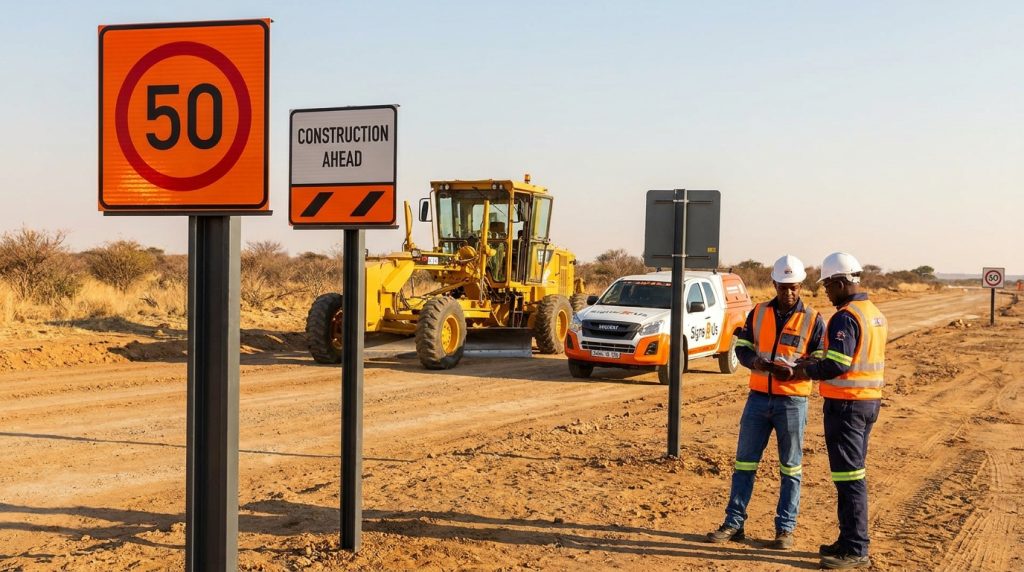
Not all traffic signs suppliers in South Africa manufacture to the same standard, and the gap between a compliant sign and a non-compliant one is rarely visible to the naked eye at the point of order. For a procurement manager working on a road project, a construction site, or a municipal infrastructure programme, that gap carries real consequences: failed inspections, rejected tender deliverables, signs that degrade within months, and in the worst cases, liability exposure when inadequate signage contributes to an incident. The question is not simply who can supply traffic signs quickly and at a competitive price. The question is who can supply signs that will still be standing up to scrutiny six months after installation.
The five criteria below are the ones that separate a reliable, specification-compliant supplier from one who resells whatever is available. Work through each before you commit to any order.
1. SARTSMA Membership
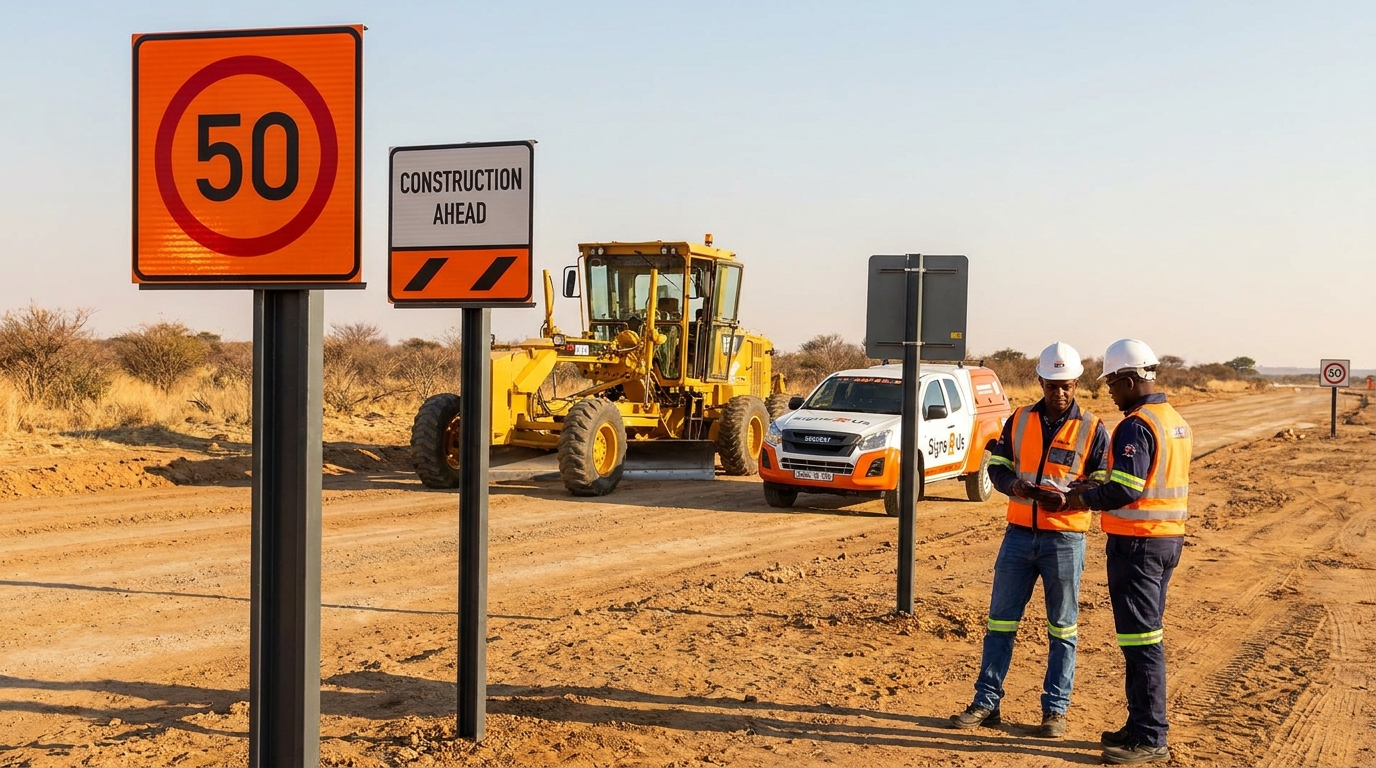
The Southern African Road Traffic Signs Manufacturers Association (SARTSMA) is the industry body that sets manufacturing standards for road traffic signs in South Africa. Membership is not automatic. Suppliers must demonstrate that their products and processes meet the association’s requirements, and members are subject to ongoing scrutiny rather than a once-off tick on a checklist.
Why does this matter in practice? SARTSMA membership gives you a baseline assurance that a supplier’s signs are manufactured with the correct substrates, finishes, and retroreflective materials for road-facing applications. It also means the supplier operates within a framework of accountability that exists beyond the sale. If a non-member supplies non-compliant signs, your recourse is limited to whatever your purchase agreement says. If a SARTSMA member supplies non-compliant signs, there is an industry body with an interest in resolving it.
What to ask: Request written confirmation of SARTSMA membership and ask for the supplier’s membership number. Any legitimate member will provide this without hesitation.
2. SABS-Approved Retroreflective Sheeting
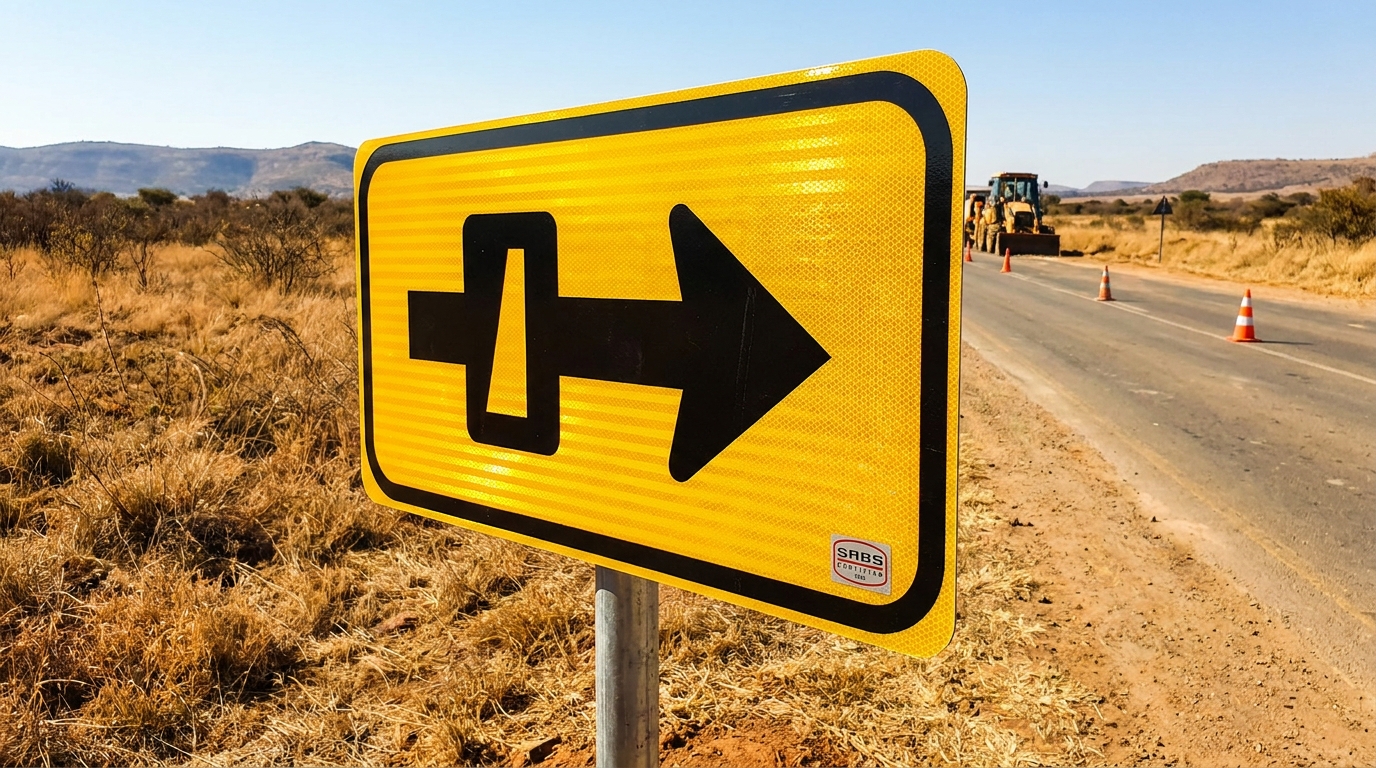
Retroreflectivity is what makes a traffic sign visible at night and in low-light conditions. It is not an optional feature. For road-facing signs, the South African Bureau of Standards (SABS) sets minimum retroreflectivity performance requirements, and the sheeting used must meet those specifications.
The challenge is that sheeting varies considerably in quality, and cheaper imported materials may look acceptable in daylight while performing well below standard after dark. Signs manufactured with substandard sheeting will also degrade faster, losing their retroreflective properties within a fraction of the expected service life. On a national road or a busy construction access route, that is a safety failure, not just a procurement inconvenience.
There are different grades of retroreflective sheeting, each suited to different applications. Type 1 engineering-grade sheeting is the minimum for many standard road signs, while higher-performance sheeting is required for high-speed roads and specific regulatory applications. A supplier who cannot tell you which grade they use, or who cannot produce documentation showing SABS approval for their materials, is a supplier worth walking away from.
What to ask: Ask specifically which grade of retroreflective sheeting is used for your sign type, and request the relevant SABS approval documentation. Also ask how long the sheeting is warranted to maintain its retroreflective performance in South African conditions.
3. COLTO Specification Compliance for Road Signs
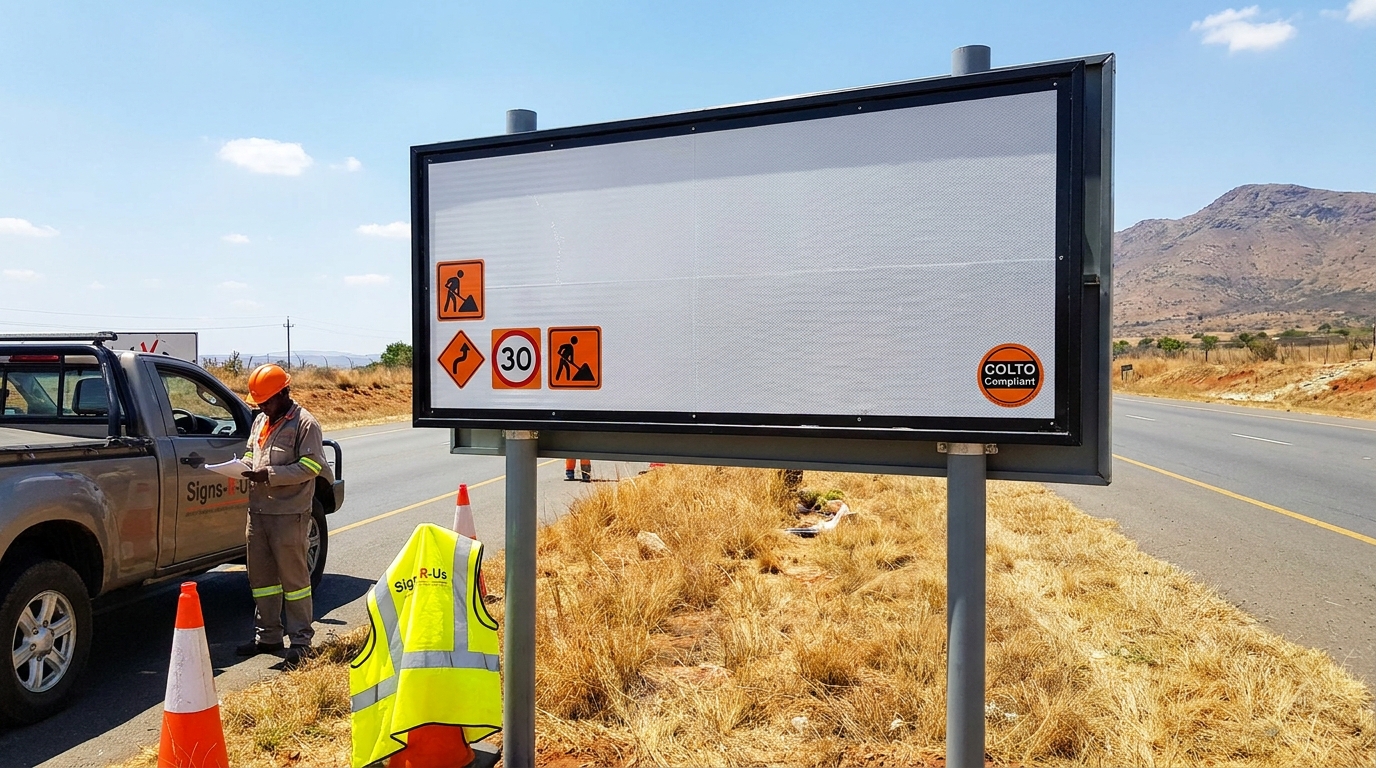
COLTO (the Committee of Land Transport Officials) publishes the technical specifications that govern road construction and associated infrastructure in South Africa, including road signs. For any project involving public roads, whether you are a contractor working under SANRAL, a provincial roads department, or a local municipality, the signs you install must comply with COLTO specifications. This covers substrate thickness, sheeting grade, legend accuracy, and the colour standards set out in the South African Road Traffic Signs Manual (SARTSM).
Non-compliance with COLTO specifications is not a minor administrative issue. It can result in the rejection of completed works, penalties under your contract, and the cost of replacing non-compliant signs at your own expense. On larger projects, it can affect your standing for future tenders.
A supplier who understands COLTO specifications will be able to confirm compliance for each sign type you are ordering, reference the relevant specification clauses, and provide signs with the correct substrate and sheeting combinations. One who is vague about specifications, or who assures you that their signs are “good quality” without being able to point to specific compliance, is unlikely to pass a formal inspection.
What to ask: Ask the supplier to confirm COLTO compliance in writing for the specific sign types you are ordering. If you are working under a specific contract specification, share the relevant sections and ask for a formal compliance statement. For a detailed breakdown of how SARTSMA and COLTO requirements interact, the article on SARTSMA vs COLTO: what signage compliance means for your project covers this in practical terms.
4. In-House Manufacturing Versus Reselling Imported Signs
This is the criterion that procurement managers most commonly overlook, and it is often the one that causes the most problems. Many businesses that present themselves as traffic sign suppliers are not manufacturers at all. They purchase imported signs, frequently from offshore producers, and resell them locally. There is nothing inherently wrong with this model for certain product categories, but for road traffic signs in South Africa, it creates several specific risks.
First, imported signs may not be manufactured to COLTO or SARTSM specifications. The dimensions, legend fonts, colour values, and sheeting grades used in other markets are not always equivalent to South African requirements, even when the sign looks broadly correct.
Second, a reseller has limited control over quality. If a batch of signs arrives with a sheeting defect or a substrate that does not meet specification, a reseller can return the batch to their supplier, but that process takes time, and you are the one holding a project deadline. A manufacturer, by contrast, can identify and correct a quality issue at the production stage before it reaches you.
Third, lead times for resellers are dependent on stock availability and import schedules. A manufacturer with in-house production capacity can confirm a realistic lead time and manage production to meet your programme.
What to ask: Ask directly whether the supplier manufactures their own signs or sources them from a third party. Ask to see photographs of or visit their production facility. Ask where their substrates and sheeting materials are sourced from, and how quality is checked before despatch.
5. CIDB Registration for Government and Infrastructure Tenders
If you are procuring traffic signs for a government project or a tender that falls under the Construction Industry Development Board (CIDB) framework, your supplier’s CIDB registration status is a compliance requirement, not a preference. The CIDB grading system establishes a supplier’s capacity and credibility for government infrastructure work, and using an unregistered or inadequately graded supplier can put your tender compliance at risk.
Beyond the formal compliance angle, CIDB registration signals that a supplier has met minimum requirements around financial standing, experience, and operational capacity. For large-scale road projects or municipal supply contracts, this matters when you are assessing whether a supplier can actually deliver at the volume and quality the project demands.
What to ask: Request the supplier’s CIDB registration number and grading. Verify it against the CIDB register, which is publicly accessible. Confirm that the grading is appropriate for the scope and value of your project.
Putting It Together Before You Issue a Purchase Order
The five criteria above are not a wish list. They are a practical checklist that protects your project, your contract, and your professional standing as the person who made the procurement decision. A supplier who can satisfy all five is not difficult to find, but it does take more than accepting the first quote that lands in your inbox.
Consider asking potential suppliers for a pre-order information pack that addresses each criterion in writing. A reputable manufacturer will have this information readily available and will welcome the request. One who pushes back, deflects, or provides vague assurances is showing you exactly what your post-order experience will look like.
It is also worth looking at a supplier’s track record on comparable projects. Signs manufactured for construction sites, for example, must comply with the Occupational Health and Safety Act as well as any site-specific requirements. The guidance on construction site signage requirements is a useful reference if your procurement covers both road-facing and site safety signs within the same project scope.
A Note on Price
Price matters, but it is worth understanding what drives the price difference between a compliant, in-house manufactured sign and a cheaper imported alternative. SABS-approved retroreflective sheeting costs more than substandard alternatives. Correct substrate thickness uses more material. Quality control at the manufacturing stage adds time. When you see a significantly lower price, the reasonable question is which of these inputs has been reduced. On a project where signs will be inspected against specification, the cheaper option frequently costs more in the end.
Signs-R-Us as a Traffic Signs Supplier in South Africa
Signs-R-Us holds SARTSMA membership, manufactures using SABS-approved retroreflective sheeting, produces signs to COLTO and SARTSM specifications, manufactures in-house rather than reselling imported products, and holds CIDB registration for government and infrastructure projects. You can verify the relevant certifications directly at the Signs-R-Us certificates page.
Whether your project requires standard road signs, construction site signage, or a custom specification, the team at Signs-R-Us will work through the technical requirements with you before production begins, not after. If you are ready to discuss your requirements and receive a specification-matched quotation, request a custom quote and a member of the team will be in touch.