
The Construction Site Signage Decision Every Safety Officer Needs to Get Right
Illustration: The Construction Site Signage Decision Every Safety Officer Needs to Get Right
Selecting the correct construction site safety signs in South Africa is one of the most consequential procurement decisions a site safety officer or construction manager will make. Get it wrong, and you face not only the risk of serious injury to workers and visitors, but potential liability under the Occupational Health and Safety Act 85 of 1993 (OHS Act) and its Construction Regulations. Get it right, and your signage becomes an active, silent safety system that communicates hazards, obligations, and emergency procedures clearly even to workers whose first language differs from the site foreman’s. This guide is designed to help you move beyond guesswork and build a structured, compliant signage plan for any construction environment.
Understanding OHS Act Alignment for Construction Site Safety Signs in South Africa
Illustration: Understanding OHS Act Alignment for Construction Site Safety Signs in South Africa
South African construction sites are governed by the OHS Act and the Construction Regulations of 2014. These regulations place a legal duty on contractors and principal contractors to identify hazards, assess risks, and implement controls — including physical safety communication in the form of signage. The regulations do not simply recommend signs; they require that hazards be communicated effectively to all persons on site.
The South African National Standard SANS 1186 provides the technical framework for safety symbolic signs. It specifies the shapes, colours, symbols, and minimum dimensions that signs must conform to in order to be considered compliant. Any OHS compliant safety sign supplied to a South African construction site should conform to SANS 1186 standards.
A key principle of SANS 1186 is the prioritisation of symbolic signs over text-only signs. Symbols transcend language barriers, a critical advantage on South African construction sites where multiple languages are spoken and literacy levels vary. Text can supplement a symbol, but the symbol must be the primary communication device.
The Four Symbolic Sign Categories Every Construction Site Requires
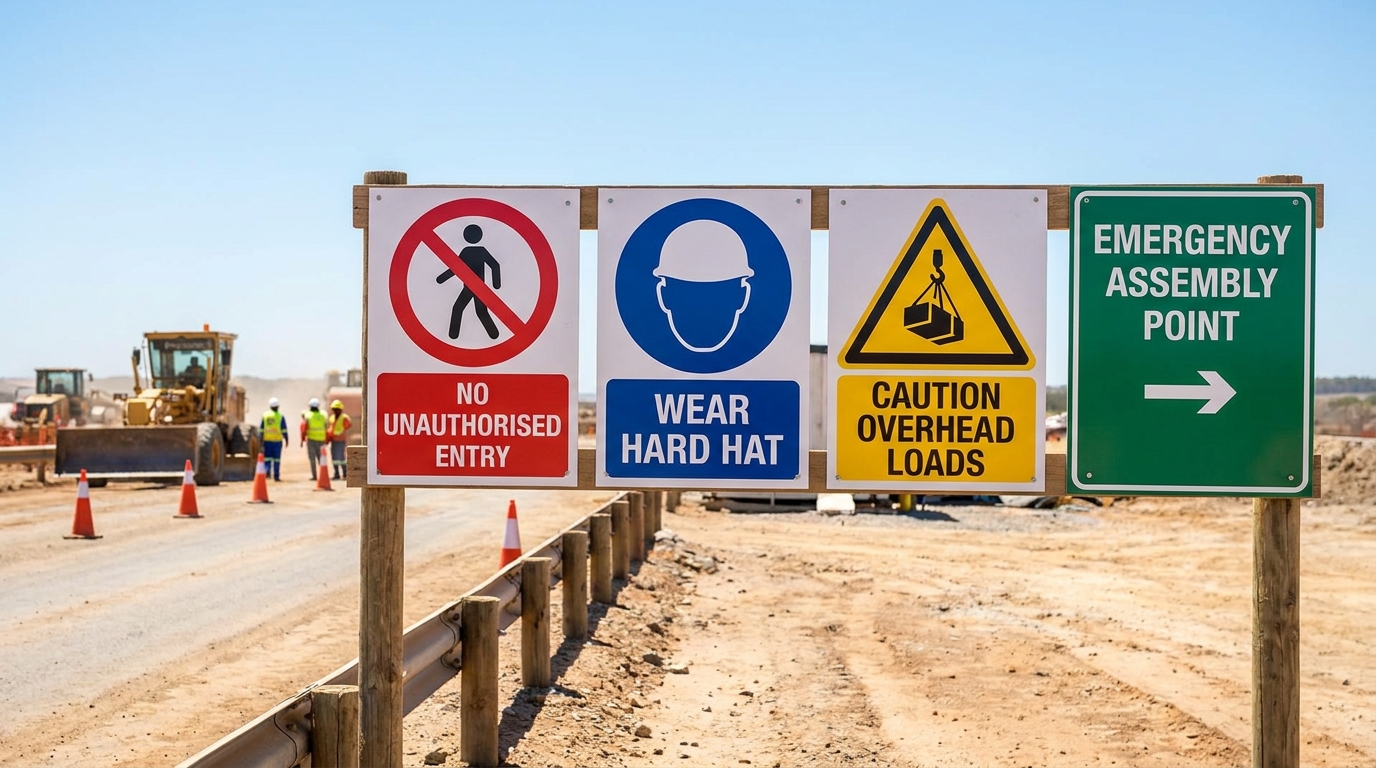
Illustration: The Four Symbolic Sign Categories Every Construction Site Requires
Understanding the four primary categories of safety symbolic signs for construction is the foundation of any compliant signage plan. Each category has a defined purpose, a standardised colour scheme, and a specific shape, all governed by SANS 1186.
1. Prohibition Signs
Purpose: To indicate actions that are not permitted on site.
Appearance: Red circle with a diagonal red bar over a black symbol on a white background.
Construction examples: No entry, no smoking, no unauthorised access, no mobile phones in restricted zones.
2. Warning Signs
Purpose: To alert persons to a hazard or hazardous condition.
Appearance: Yellow triangle with a black border and a black symbol.
Construction examples: Risk of falling objects, overhead crane operating, electrical hazard, slippery surface, excavation in progress.
Warning signs are among the most heavily used categories on active construction sites. Signs R Us offers a comprehensive range through our Warning Signs category, including options suited to both indoor and outdoor construction environments.
3. Mandatory Signs
Purpose: To indicate actions that must be carried out.
Appearance: Blue circle with a white symbol.
Construction examples: Hard hat must be worn, safety harness required, safety boots compulsory, high-visibility vest must be worn.
4. Emergency and Safe Condition Signs
Purpose: To indicate emergency exits, first aid points, muster stations, and safe routes.
Appearance: Green rectangle or square with a white symbol.
Construction examples: Emergency exit, first aid kit location, emergency assembly point, eyewash station.
Emergency signs are non-negotiable on construction sites. They must be positioned so that they are visible at all times, including during a power failure. This is where photoluminescent materials become essential, as discussed in the material selection section below. Browse our Information Signs category for emergency, first aid, and safe condition signs suitable for construction site use.
Sign Type Comparison: Which Sign Goes Where on a Construction Site
|
Sign Category |
Colour / Shape |
Typical Construction Use Cases |
Placement Priority |
|---|---|---|---|
|
Prohibition |
Red circle / diagonal bar |
Site entrances, restricted zones, plant areas |
Entry and access control points |
|
Warning |
Yellow triangle |
Excavations, crane zones, electrical panels, scaffolding |
At or before the hazard location |
|
Mandatory |
Blue circle |
PPE requirements at site entry, work zones, confined spaces |
Before entering the zone where PPE is required |
|
Emergency / Safe Condition |
Green rectangle |
Site offices, welfare facilities, escape routes, assembly points |
Along all egress routes; must be visible in low light |
|
Fire Equipment |
Red rectangle |
Fire extinguisher locations, hose reels, fire points |
At each fire equipment station; unobstructed sightlines |
Choosing the Right Material for Construction Site Safety Signage
Material selection is where many procurement decisions fall short. A sign that fades, warps, or becomes illegible after a few months of South African summer sun, dust, and moisture is not a safety solution; it is a liability. The environment in which a sign will be installed should drive the material choice as much as the sign category itself.
ABS Plastic
ABS (Acrylonitrile Butadiene Styrene) is a rigid, impact-resistant plastic that offers excellent durability in most construction environments. It is lightweight, easy to mount, and holds colour well when UV-stabilised. ABS signs are well suited to semi-permanent installations inside structures under construction, in site offices, and in welfare facilities. They are a cost-effective option where signs will be re-used across multiple projects.
Chromadek Steel
Chromadek is a pre-painted galvanised steel sheeting product widely used in South African signage for its robustness and weather resistance. For outdoor construction sites, particularly in coastal regions, dusty inland environments, or high-traffic areas where signs may be knocked or struck, Chromadek offers superior rigidity and longevity. Signs R Us uses Chromadek for site safety signage that needs to withstand the full force of the South African climate.
Chromadek is the preferred material for large-format site hoarding signs, perimeter safety notices, and any signage that will be exposed to direct sunlight, rain, or physical impact over an extended period.
Photoluminescent (Glow-in-the-Dark) Material
Photoluminescent signs absorb ambient light and emit a green glow in low-light or no-light conditions. Under SANS 1186 and the South African National Building Regulations, photoluminescent signs are required for emergency evacuation routes and exit signage in areas where artificial lighting may fail during an emergency. On construction sites, this applies to stairwells, basements, plant rooms, and any temporary structure where workers may be present during a power outage.
Photoluminescent signs require no power source and no wiring, making them a practical and code-compliant choice for construction environments where electrical infrastructure is incomplete or temporary.
Material Selection at a Glance
-
ABS Plastic: Semi-permanent indoor use, site offices, welfare areas, reusable across projects
-
Chromadek Steel: Outdoor and perimeter signage, high-impact zones, long-duration projects
-
Photoluminescent: Emergency exit routes, stairwells, low-light or no-light areas, OHS and building regulation compliance
Site Safety Signage Requirements: Placement Principles That Make Signs Work
A correctly specified sign installed in the wrong location fails its purpose entirely. South African site safety signage requirements expect that signs are not only present, but effective. Here are the placement principles that experienced safety officers apply:
-
Position before the hazard, not at it. A warning sign for an excavation should be visible before a worker reaches the edge, not mounted on the barrier directly above the drop.
-
Mount at eye level where possible. For pedestrian zones, signs should be mounted between 1.5 m and 1.8 m from ground level. For vehicle operators, signs must be visible from the cab.
-
Ensure unobstructed sightlines. Signs obscured by equipment, materials, or other signage are non-compliant. Regular site audits should include a signage visibility check.
-
Account for lighting conditions. In areas with poor or variable lighting, photoluminescent or retroreflective materials are necessary. Do not rely on standard printed signs in dark or low-light zones.
-
Replace damaged or faded signs immediately. A worn sign is legally equivalent to no sign. Build sign replacement into your site safety maintenance schedule.
-
Increase sign frequency in high-risk zones. Areas with multiple concurrent hazards, such as an active crane zone near an excavation, require multiple sign categories displayed together.
Building a Compliant Signage Plan: A Practical Framework
For procurement managers sourcing construction site safety signs in South Africa, a structured approach reduces the risk of gaps in coverage. Use the following framework as a starting point:
-
Conduct a hazard and access audit. Walk the site and map every entry point, hazard zone, work area, and emergency route. This becomes your signage placement plan.
-
Assign sign categories to each location. Use the four SANS 1186 categories to determine what type of communication is needed at each point.
-
Select materials based on environment. Apply the material guide above outdoor, indoor, low-light, high-impact to specify the correct substrate for each sign.
-
Verify SANS 1186 compliance. Confirm that all signs meet the colour, symbol, shape, and minimum size requirements before ordering.
-
Schedule regular audits. Assign responsibility for monthly sign inspections to a named person on the site safety team.
When Your Construction Project Includes Road-Facing Signage
Many construction sites interface with public roads whether through site entrance signage, pedestrian diversion notices, or temporary traffic management. These signs fall under a separate regulatory framework and require compliance with South African road traffic sign standards. Signs R Us provides a full road and traffic signage service for contractors who need to manage the road-facing boundary of their construction sites safely and compliantly.
Work With a Supplier Who Understands South African Construction Signage
Signs R Us supplies OHS compliant safety signs to construction sites, contractors, and principal contractors across South Africa. Our range covers all four SANS 1186 symbolic sign categories, available in ABS, Chromadek, and photoluminescent materials manufactured to withstand South African site conditions and meet the legal requirements of the OHS Act and Construction Regulations 2014.
Whether you are equipping a single residential development or a large-scale commercial construction project, our team can help you specify the right signs for every zone on your site. Contact Signs R Us today to discuss your construction site signage requirements, request a quote, or access our full catalogue of site safety signage solutions.